
Ohio Highway Patrol Arrests
OSHP stands for the Ohio State Highway Patrol, part of the Ohio Department of Public Safety. It handles highway enforcement across the state. Its arrest material usually comes out of patrol work, impaired-driving campaigns, crash investigations, checkpoints, and district announcements. A release covers selected activity. It is never a list of everyone a trooper arrested.
That gap matters when a name turns up nowhere. The Patrol may have made an arrest and issued no news item. Campaign items often give totals and skip names entirely. So an OSHP arrest news record reads as an agency report of enforcement work, not a court docket.
The Patrol also puts out broader safety material. A traffic-data dashboard and an annual report describe its statewide work. Neither works as a person-level custody tool. For one case, ask three questions instead: which agency made the arrest, which office holds the incident record, and which jail did the booking.
Where OSHP Arrest News Appears
Each official channel serves a different purpose. GovDelivery posts dated enforcement announcements and district or post releases. The traffic dashboard adds statewide traffic and OVI context. A yearly report sums up a fixed period. Treat none of them as a live jail roster, since the source page sets the detail and its publication date.
One OSHP enforcement bulletin shows how this works. It reports 158 impaired drivers removed from Ohio roads, plus other enforcement totals. A second OSHP enforcement bulletin gives another campaign count of 355 impaired drivers. Each figure covers its own event and scope. Neither is a name-by-name roster.
| Official channel | What it can show | What it does not establish |
|---|---|---|
| OSHP GovDelivery stream | Dated Patrol news, enforcement campaigns, district or post announcements, and selected arrests. | It is not a complete daily arrest or booking feed. |
| Ohio Traffic Data dashboard | Traffic and OVI data used to view patterns and public-safety context. | It does not replace a person-specific report or custody check. |
| 2024 Public Safety annual report | A dated account of statewide Department of Public Safety operations. | It is historical reporting, not a current booking screen. |
Social posts can point you toward a release. But the GovDelivery bulletin or the record behind it makes the stronger citation. The Ohio Traffic Data page may be down. It may simply stay silent on custody questions. When no release exists, use the records channel for the event. Do not read silence as proof that no arrest happened.
View the official OSHP campaign release. It shows how the Patrol frames a statewide enforcement result. Carry its date and wording along with any summary of the numbers.
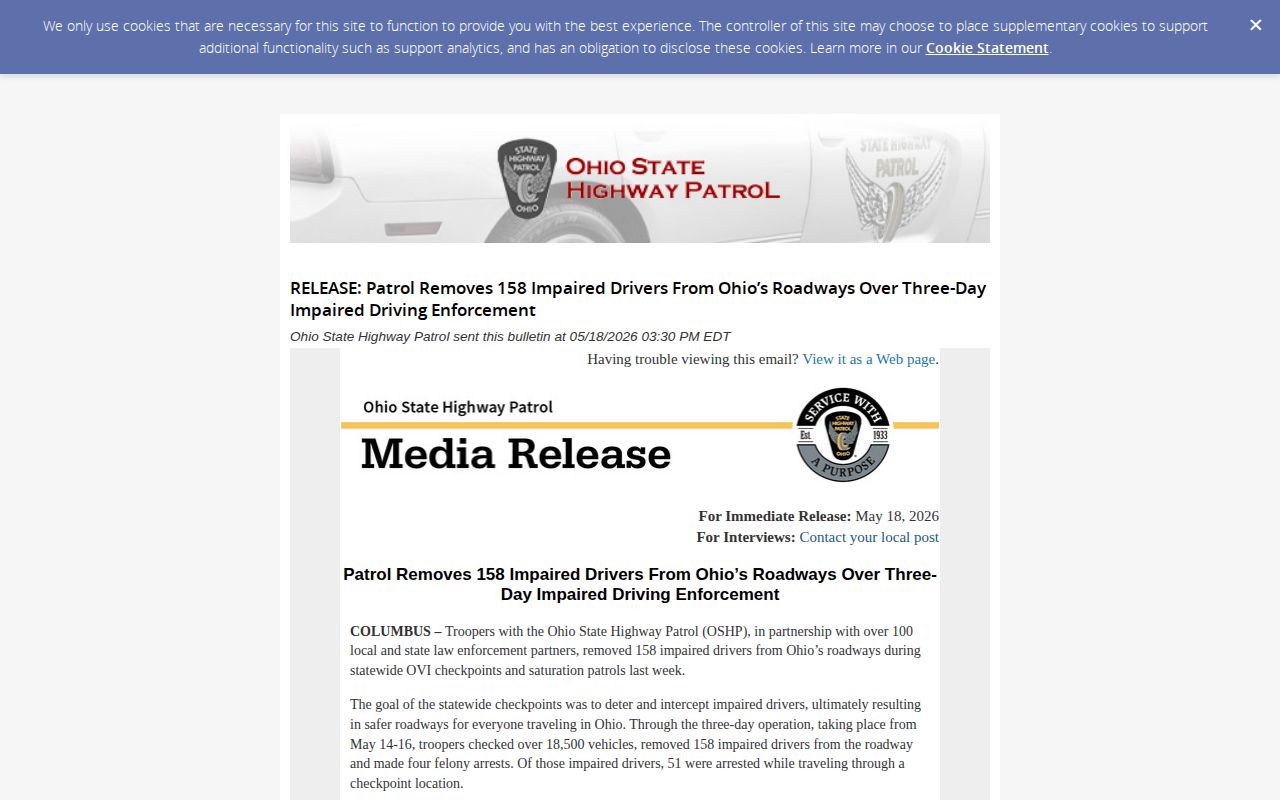
This page is an agency publication. It is not a booking-photo display. Use it to understand the Patrol's news channel and the limited arrest detail it publishes.
Note: A campaign total describes the operation named in the release; it should not be carried forward as a current or statewide custody count.
How to Find an OSHP Arrest
Begin with what you know. That means an event date, a county, a road or location, and the record type you want. Scan the official release stream for a matching campaign or case announcement. A release can confirm that OSHP reported an arrest. It may still leave out the name or the full incident record. For booking status, go on. Turn to the county or regional facility that held custody.
Keep the arresting agency and the booking office separate as you search.
- Check the OSHP bulletin stream for a dated enforcement release. Read the item’s scope, event dates, district or post, and whether it reports a named case or only totals.
- Identify the county or regional facility tied to the event. Use the Ohio County Directory to open the local recent-arrests route, then follow that county’s official roster or records contact.
- If the event is very recent, compare the county’s current-custody view with its dated arrest or media log. A live roster and a news release cover different records and can update at different times.
- Ask the OSHP or DPS records office for the incident or arrest record when the publication does not answer the question. Give enough event details to locate the file.
If the question is whether someone is in custody right now, a statewide release is the wrong place to stop. The jail itself can confirm its current status. For county booking views closer to real time, the statewide 24 Hour Arrests page shows how Ohio's same-day sources differ and how to route to the right county system.
Where OSHP Arrestees Are Booked
OSHP makes arrests but runs no statewide county-jail booking roster. A trooper's arrestee normally goes to the county jail. Some go to a regional jail instead. Others land in a municipal facility or with another custodian handling the charge. That booking agency creates the booking record and any booking photo it takes. So one case can carry two different agency names.
The exact route depends on the charge and the custody call. Some people get a citation and go free. Others move to medical care instead. Some get held on another agency's warrant. A few enter a federal or out-of-state process. Each situation changes what a county roster can show. A roster lists its own custody data, not every OSHP contact across Ohio.
The originating county or facility controls the booking record and photo, if one is public. That office answers questions about the entry. The court file tells the rest of the story.
Once a case moves past sentencing, the picture changes. The Ohio Department of Rehabilitation and Correction's Offender Search tracks that later trail. It lists people held in Ohio prisons. It also covers anyone under ODRC supervision. Judicial release cases appear there too. It will not serve as a county booking search. A fresh OSHP arrest belongs in a different lookup.
Note: The receiving custodian, rather than the arresting trooper’s news channel, controls the booking record and any photo it publishes.
Request an OSHP Arrest Report
Start with the Ohio Department of Public Safety Public Records portal. Label the request as an OSHP or DPS record. Crash records have a faster lane: the Ohio Traffic Data and Crash Online portal. Name a specific record. The agency will not build a statewide list or answer open-ended questions for you.
Ohio Revised Code § 149.43 governs the timeline. Public offices must respond promptly, within a reasonable period. No single deadline fits every request. Retrieval, review, redaction, legal consultation, volume, and format all shape the wait. Ordinary copies can be billed at actual cost, and video may carry preparation and redaction charges under a lawful policy. OSHP posts no fixed booking-photo fee or guaranteed turnaround.
Before submitting, narrow the request to the event and the records needed:
- Include the case or crash number if known, plus the date or date range, county, road or location, and OSHP district or post if available.
- Name each record type requested, such as an incident report, arrest-related report, citation, audio, dash-camera or body-camera record, toxicology material, or booking referral.
- Ask the office to release routine factual portions that can be separated from protected material, and to state the legal basis for any denial or redaction.
- Keep the response and any follow-up. Send a separate request to the jail or county custodian for the booking record, booking photo, or release record it holds.
Ohio law shields several categories from release. Confidential investigative material, juvenile details, victim information, and protected sources can all be withheld. A partial release is sometimes the lawful outcome. Also note that an arrest report request differs from one for the booking photo, which the receiving facility may hold rather than OSHP.
OVI and Campaign Arrest Results
Campaign releases show what enforcement the Patrol ran and which totals it chose to publish. One bulletin counts 158 impaired drivers removed from Ohio roads. Another reports 355. Those numbers belong to their own releases. They are not annual statewide arrest totals. They are not a count of all Ohio bookings either, and they predict nothing about a single county.
Checkpoint notices work the same way. Each describes a planned or completed enforcement event. Read every one for its own period, agency scope, and measures. A release may tally arrests, citations, crashes, or contacts in different ways. Combining unlike measures into one arrest trend distorts the record. The Ohio Traffic Data dashboard and the dated Public Safety annual report add context, though a person-specific question still needs the underlying agency or court record.
OSHP news answers questions about Patrol activity best. For custody and booking, the county or regional jail is the right next stop. Court records carry the later case events. ODRC handles the post-sentencing state-corrections side. Keeping these sources straight keeps each record honest about what it actually shows.